Project Methodology
Our philosophy
Implementing an ERP system is as challenging as it is valuable. Odoo connects all departments and workflows, which means changes in every aspect of your company. Done well, it transforms how your people work - automating repetitive tasks, standardising processes and making your business more productive.
We have learned - through many successful implementations - that simplicity, clear communication and disciplined scope management are what separate successful projects from failed ones.
Our project phases (timelines are indicative only)
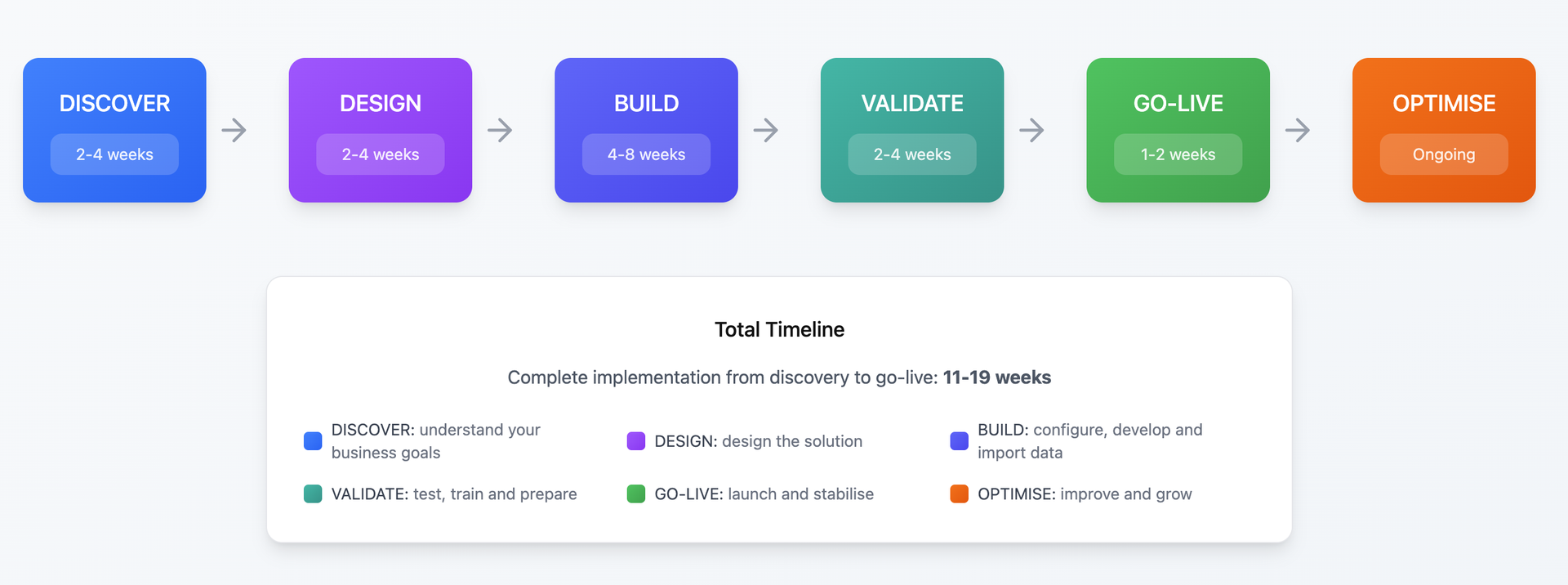
Phase 1: Discover
Goal: Understand your business, processes and goals before we touch the system.
Activity | Output |
|---|---|
Business process workshops | Process maps (AS-IS) |
Gap analysis | Fit/gap report - what Odoo covers, what needs customisation |
Data audit | Data migration plan and quality assessment |
Requirements documentation | Signed-off requirements document |
Project planning | Project plan, timeline, resource plan and budget |
We recommend: Approve and fund the Discovery phase separately before committing to the full project. It is low cost, low risk and gives you real data to make the big decision.
Phase 2: Design
Goal: Define exactly how Odoo will be configured to support your business.
Activity | Output |
|---|---|
Solution design workshops | TO-BE process maps |
Module and feature mapping | Detailed configuration specification |
Integration design | Interface specifications |
Data migration mapping | Field-by-field mapping from source to Odoo |
Custom development scoping | Development specifications and estimates |
Phase 3: Build
Goal: Configure, develop and populate the system.
Activity | Output |
|---|---|
System configuration | Working Odoo environment matching design |
Custom development | Tested custom code and integrations |
Data migration (trial 1) | First data load - validate quality and mapping |
Data migration (trial 2) | Second data load - refine and verify |
Integration development | Working connections to external systems |
We insist on a minimum of 2 trial data migrations. Data is always messier than expected.
Phase 4: Validate
Goal: Prove the system works before go-live.
Activity | Output |
|---|---|
User Acceptance Testing (UAT) | Signed test results |
End-to-end process testing | Verified complete workflows |
Key user training | Trained key users who can support their teams |
End user training | All users able to perform daily tasks |
Training documentation | User guides and quick-reference materials |
Go-live readiness assessment | Go/no-go decision with criteria |
Phase 5: Go-Live
Goal: Launch the system and stabilise.
Activity | Output |
|---|---|
Final data migration | Production data loaded |
Go-live cutover | System live for all users |
Intensive support (hypercare) | On-site or remote support for 1-2 weeks |
Issue resolution | Rapid response to any problems |
Daily check-ins | Proactive monitoring of system and user adoption |
Phase 6: Optimise
Goal: Continuous improvement after go-live.
Activity | Output |
|---|---|
Post go-live review | Lessons learned and improvement plan |
Process refinement | Adjusted workflows based on real usage |
Additional training | Targeted training for areas that need it |
Phase 2 planning | Roadmap for additional modules or features |
Monthly patching | Keep system current and secure |
Roles and responsibilities
Role | Responsibility | Provided by |
|---|---|---|
Executive sponsor | Strategic decisions, budget, resource allocation, conflict resolution | Customer |
Project manager | Day-to-day project management, planning, risk management, communication | Linserv or Customer (depends on engagement model) |
Key users | Business requirements, process validation, UAT, training support | Customer |
Odoo consultant | Configuration, best practice guidance, process design | Linserv |
Technical consultant | Development, integrations, data migration, infrastructure | Linserv |
End users | Testing, training participation, feedback | Customer |
Success factors
Based on our experience, the following factors most strongly predict project success:
Factor | Why it matters |
|---|---|
Executive sponsorship | Someone must have authority to make decisions, allocate resources and break deadlocks |
Dedicated key users | Part-time participation leads to delays. Minimum 30-50% dedicated time |
Scope discipline | Agree on scope early. Change requests are normal - but uncontrolled scope creep is the #1 project killer |
Data quality | Bad data in = bad system out. Invest time in cleaning data before migration |
Standard over custom | Adapt your process to Odoo standard wherever possible. Every customisation adds cost and maintenance burden |
Testing | Never skip UAT. Real users testing real scenarios is the only way to catch problems before go-live |
Change management | People resist change. Communicate early, involve users and celebrate progress |
For details on our engagement options, see → [2.0 How We Work: Engagement Models]